The Wild Economics of SaaS Replacement
How $1 million in retired SaaS spend can become roughly $8.3 million in enterprise value.
- Format
- Industry keynote, association session, or portfolio briefing
- Length
- 30 minutes plus guided Q&A
- Best for
- Industry associations, private-equity portfolios, CEOs, CFOs, and operating partners
The question
Can $1 million in SaaS spend become $8.3 million in enterprise value?
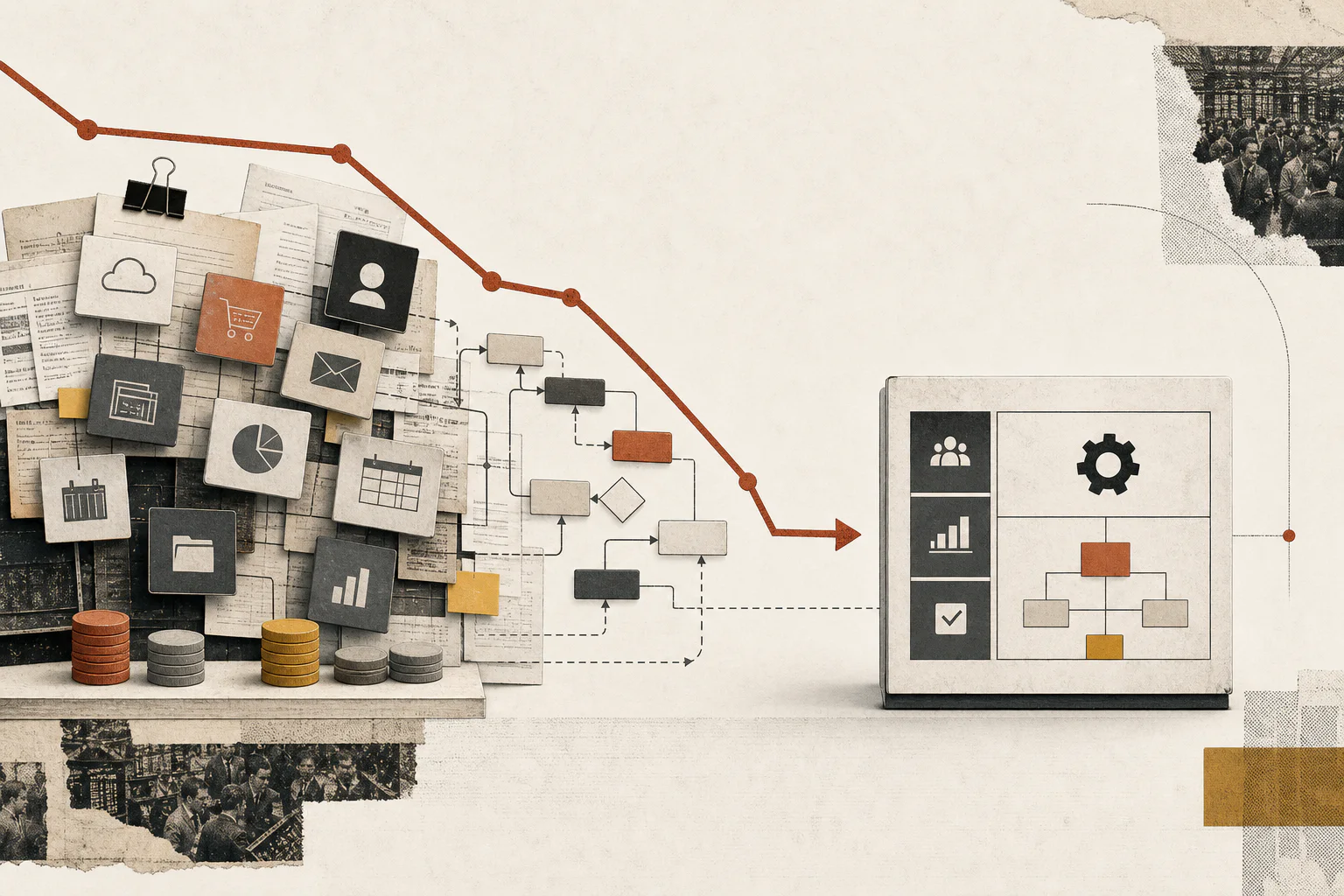
The economics of business software changed faster than most company budgets. In the illustrative case, a company retires $1 million in annual SaaS spend with a $500,000 build. The replacement produces about $925,000 in recurring savings. At a 9x multiple, that could add roughly $8.3 million in enterprise value. This session works through the calculation, keeps the cash and valuation cases separate, and shows where the math breaks.
Tailored for this audience. The software budget changes by sector. Trade groups can nominate an anonymized member stack, and portfolio groups can use a pattern that appears across several companies.
Main example
The $8.3 million line in the software budget.
I work through the full illustrative model: $1 million in annual SaaS retired, a $500,000 build, roughly ten months to project-level payback as contracts roll off, and about $8.3 million in potential enterprise value if $925,000 of recurring savings reaches EBITDA at a 9x multiple.
Watch the 10-minute argumentHow it runs
The session, end to end.
- 01 / Audit
Open the software budget
A prepared company case exposes annual spend, renewal timing, workflow pain, and the systems employees barely use.
- 02 / Underwrite
Run the replacement math
The audience works through the build cost, operating burden, cutover timing, cash return, and potential effect on enterprise value.
- 03 / Decide
Choose what stays rented
The final step separates a credible replacement from a custom liability and produces a short sequence for the first candidate.
What people take home
What people can do next.
- Find the replacement candidates hiding in the software budget.
- Underwrite the cash return and potential enterprise value without counting the same savings twice.
- Sequence one high-confidence replacement while leaving commodity and compliance-heavy systems in place.
Bring it to your group
Bring me the problem your team is trying to solve.
Tell me who is coming and what they need from the session. I'll recommend the talk and format that fit.
Ask about booking